The irony of infrastructure management is that its greatest achievements are often invisible.
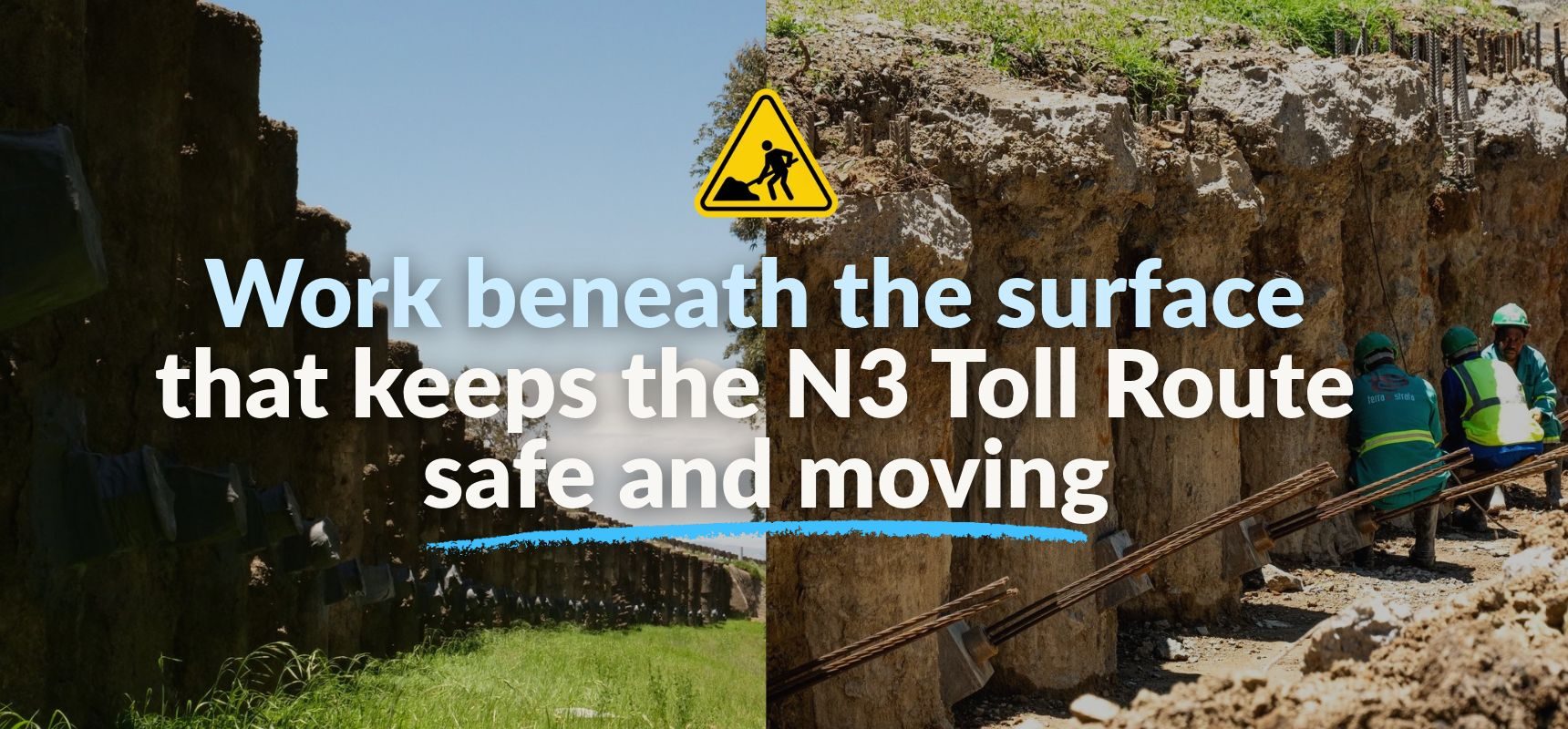
Drivers notice lane closures, construction vehicles, fresh asphalt, new bridges and changes to road layouts. They rarely see the boreholes drilled months earlier to investigate a slope, anchors buried deep in the ground to stabilise embankments, or drainage pipes redirecting groundwater.
“These unseen interventions help ensure that a road withstands weather, ecological, and traffic impacts. The success of this ‘invisible’ work is defined by what does not happen: a slope that stays in place, flooding that does not occur, and a road that remains safe and open under the greatest pressures,” says Thania Dhoogra, chief operating officer of N3TC.
“These efforts are particularly important on the 415 km N3 Toll Route between KwaZulu-Natal and Gauteng, which carries a large share of South Africa’s freight. Reliability is not created by only repairing failures after they occur. It largely depends on identifying potential problems early, understanding their impacts, developing solutions, and intervening at the right time.”
Van Reenen Pass, connecting KwaZulu-Natal to the Free State, is a familiar yet challenging section of the route. The landscape rises and falls, weather conditions change quickly, and trucks must negotiate steep gradients. For road users, this mountainous section can present unpredictable conditions and requires careful navigation.
Below the road surface, engineers monitor rock and soil settlement, cracking, water flow and seepage, particularly after heavy rainfall, as well as any erosion that may occur.
“This is when our engineers become detectives,” explains Ms Dhoogra.
To the casual observer, cracking of the road surface or along the embankment might look like a relatively simple repair job. In reality, it raises numerous geotechnical and environmental questions that must be thoroughly investigated to determine all the possible risks.
Where did the move start? Is there soil erosion or slope instability? Is instability global or local? Are drainage issues, leaks, or structural defects contributing to or causing the problem? How deep do the cracks extend? Where does the water come from? What is happening in the soil and rock layers beneath the road and deep below the surface?
Armed with the answers to these questions, N3TC’s engineering team and their specialists can identify the best solutions and implement the necessary interventions to mitigate against slope failures and protect the environment from possible future erosion and ground movement.
Stabilising the embankment along Van Reenen Pass
As part of a comprehensive geotechnical management system, survey beacons were installed to understand the surface movement of the slopes. In addition, inclinometers and moisture sensors were installed beneath identified slopes for continuous monitoring for the behaviour of the slopes. During 2024, analysis of the investigation survey data identified instances where natural soil and weathered rock had begun to move downslope, accumulating at the base of one of the steep embankments, as well as a possible underground drainage pathway.
Boreholes were drilled for a closer look. Laboratory testing and slope-stability modelling then helped the engineers understand how the different layers were behaving and where intervention would have the greatest impact.
Holding a mountain in place
Following the identification of underground movement, an anchored pile wall was designed to protect the mid-slope along this critical section of the N3 Toll Route. Large, 900 mm-diameter concrete piles were installed to resist sideways movement, while steel anchors were fixed deep into the ground to withstand the pulling forces and hold the structure in place.
Construction started in June 2024, during the drier winter season.
Drilling soon encountered large talus boulders and voids at isolated drilling locations. In one pile hole, concrete disappeared into the voided ground, requiring approximately 136% more concrete than originally planned.
Over the course of the project, the rains returned, with groundwater adding additional complexity to the technical works. Engineering skill and experience were required throughout this project to adapt to the changing conditions and successfully implement the solution before year-end with busier traffic conditions and heavier rains expected during the summer holiday.
The project was delivered on time, within budget, and is monitored continuously for movement and moisture.
Lessons from Van Reenen Pass are repeated along the route
Van Reenen Pass is not the only section of the N3 Toll Route requiring this level of geotechnical attention.
The route crosses some of the most demanding terrain on South Africa’s freight network. Between Cedara and Heidelberg, it encounters steep gradients, cut slopes, high embankments, variable geology, intense rainfall, and high volumes of heavy vehicle traffic.
Maintaining the route has therefore involved a robust programme of rehabilitation and protection. Some interventions are familiar to road users, including resurfacing, resealing, and reconstruction of heavily trafficked lanes. Others are less obvious.
At different locations, slope and embankment problems have required measures such as anchors, high-tensile mesh, grouting, retaining structures, surface- and underground drainage and erosion protection. Where a slip has reached the road prism, the response may involve reconstructing the failed section while addressing the underlying instability, rather than simply replacing the damaged pavement.
In KwaZulu-Natal, the Mooi River area provides a good example. A localised slope failure affected the N3 Toll Route over a section of approximately 100 m long and up to 10 m high. The remedial approach incorporated drilled anchors, grouting, and high-tensile steel mesh to stabilise the slope.
Further south, a slip repair at Lions River demonstrates another aspect of this work. The problem was not simply a pothole or damaged asphalt. The ground itself had moved, requiring a permanent engineering intervention to restore stability.
More recently, slope repair and stabilisation work has continued elsewhere on the route, including between Keeversfontein near Ladysmith and Van Reenen.
“These projects remind us that a highway is much more than an asphalt pavement. Roads are built on engineered platforms. These platforms rest on massive earthworks that interact with natural slopes, groundwater and surface drainage. Around all of this are living landscapes that must respond to rainfall, vegetation, and erosion. If one part of that system changes, another part may be affected,” continues Ms Dhoogra.
Water is another recurring factor
As essential as water is to biodiverse landscapes, uncontrolled water can be one of the greatest threats to road infrastructure. On a route like the N3, the aim is not to eliminate water, but to understand its source, direction, and safest path.
“N3TC’s environmental and engineering objectives work closely together. Our environmental management programme includes water monitoring, erosion control, gabions, earth berms and grouted stone pitching, as well as vegetation management, topsoil placement, grass, and natural erosion protection. From an engineering perspective, drainage, slope management, and stabilisation are closely linked to these interventions,” continues Ms Dhoogra.
“A stable slope needs water to be controlled; a rehabilitated slope needs soil to be protected; and a functioning drainage system protects both the road and the surrounding environment.”
Working with the landscape
A road such as the N3 Toll Route crosses grasslands, wetlands, freshwater systems, and agricultural landscapes, with communities and businesses depending on the surrounding environment.
A major intervention can therefore not be judged solely by whether the road has been repaired or not.
Over the past 25 years, N3TC’s environmental management programme has developed extensively around water and vegetation monitoring; firebreak and steep-slope management; contaminated-land rehabilitation; alien-vegetation control; topsoil placement; grass and natural erosion protection; and other erosion-control measures.
“Each element has a purpose, helping to keep the road network healthy,” explains Ms Dhoogra.
“The next time you travel on the N3 Toll Route, keep in mind that a road is more than the surface beneath your wheels. It is a layered, living system, and keeping it safe requires careful management of every part,” she concludes.