
N3 Traffic Advisory | Careful planning and defensive driving are critical as road users start their return journey
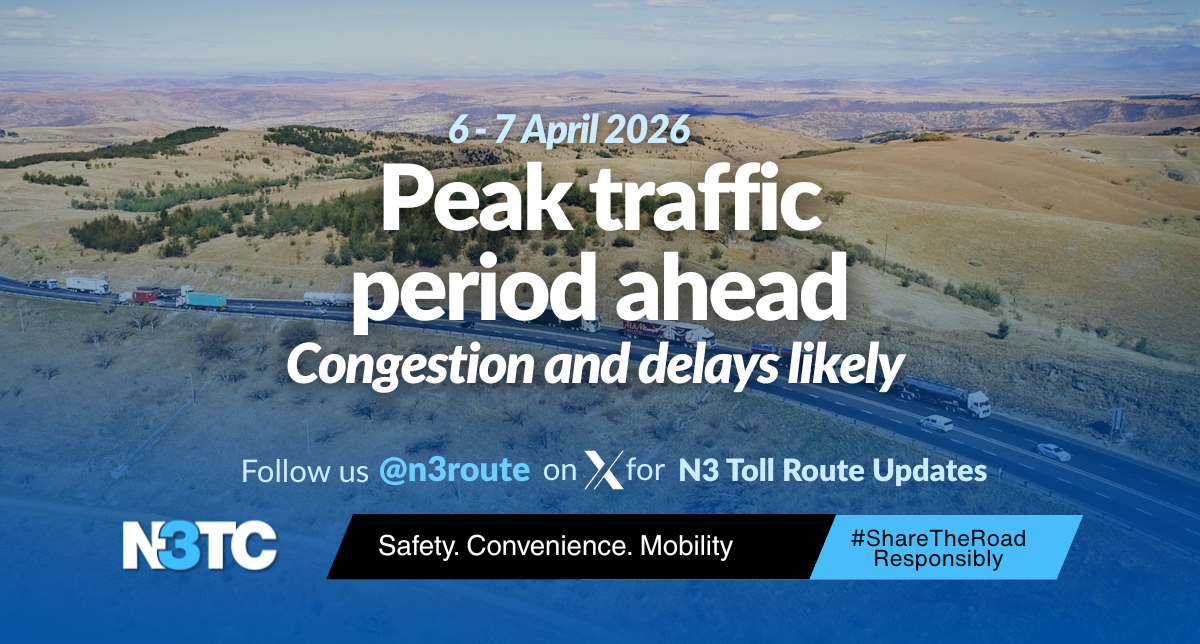
Road users are advised to plan for high traffic volumes and sudden in changes in the weather on the N3 Toll Route over the coming days as they set out on their return journeys at the end of the holiday period.
Sudden changes in weather, as well as heavy traffic volumes and crash incidents, may disrupt traffic flow along various parts of the route during the upcoming peak travel period.
“We, therefore, encourage motorists to be prepared for changing travel conditions and to allow sufficient travel time for possible delays or emergencies. Demands on drivers increase as traffic volumes rise, and become more pressing after long hours on the road, when fatigue sets in, or darkness falls,” explains Thania Dhoogra, chief operating officer of N3TC, the company managing the N3 Toll Route between Cedara in KwaZulu-Natal and Heidelberg in Gauteng.
“If possible, please avoid last-minute or night-time travel. We recommend road users plan their return trips to allow sufficient time for rest stops, slow-moving traffic and possible delays,” advises Ms Dhoogra.
Driver behaviour remains a major contributing factor to crashes. Data from 2025 indicates that 83% of light motor vehicle crashes, and 80% of heavy motor vehicle crashes on the N3 Toll Route, were attributable to driver error and/or negligence. Many of these incidents were single-vehicle crashes, where drivers lost control, and their vehicles left the road, or rolled.
Head-on collisions, often caused by risky overtaking, and multi-vehicle incidents, also remain a matter of concern during peak periods.
“The force of impact in head-on crashes, and the severity of injuries sustained, are often fatal or life-altering,” says Ms Dhoogra.
With the end of the Easter long weekend and the autumn school holidays coinciding, increased volumes of public transport vehicles, leisure travellers and freight traffic are expected on the N3 Toll Route.
“We urge motorists to make allowances for slower, heavy motor vehicles, like trucks and buses, along the route,” continues Ms Dhoogra.
“There is a significant speed differential between heavy vehicles and faster-moving light vehicles. The maximum speed limit for public transport vehicles is 100 km/h, while heavy motor vehicles are limited to 80 km/h, subject the sign-posted speed limits ofcourse. ”
She reminded motorists that it is “equally unsafe to cut in front of a heavy vehicle, as sudden braking may lead to loss of control or jack-knifing, and to never tailgate trucks and buses.”
“Truck drivers cannot see vehicles travelling too closely behind them due to blind spots. Always maintain a safe following distance and only overtake when it is safe and visible,” stresses Ms Dhoogra.
High-risk behaviour and poor judgement carry severe consequences, often resulting in significant physical, emotional and financial trauma.
“A few simple safety measures — maintaining a safe following distance, adhering to speed limits or reducing speed in poor conditions, NEVER overtaking on blind rises or solid lines, avoiding distractions, not using mobile devices while driving, only ever driving sober, and remaining alert and patient — can help save lives,” explains Ms Dhoogra.
Additional road safety and emergency resources are deployed on the N3 Toll Route
N3TC Route Services and their road incident management system (RIMS) partners are on high alert to monitor conditions, assist road users and promote safety.
Expected peak traffic volumes
Traffic volumes of between 1 500 and 2 500 vehicles per hour are expected tomorrow (Monday, 6 April). While most traffic will be heading northbound towards Gauteng, busy conditions may also occur southbound towards KwaZulu-Natal.
Peak volumes are expected from 09:00 on Monday, with similar conditions on Tuesday (7 April).
Should it be deemed necessary, the Road Traffic Inspectorate (RTI) may implement special traffic control measures, particularly along Van Reenen Pass.
N3TC’s Route Control Centre (RCC) coordinates emergency responses. Road users can access verified updates via @N3Route on X or contact the 24-hour N3 Helpline on 0800 63 43 57.
“We wish all road users a safe and pleasant return journey. Drive so that everyone arrives safely home,” concludes Ms Dhoogra.
ENDS.
Issued by: N3 Toll Concession (N3TC)